


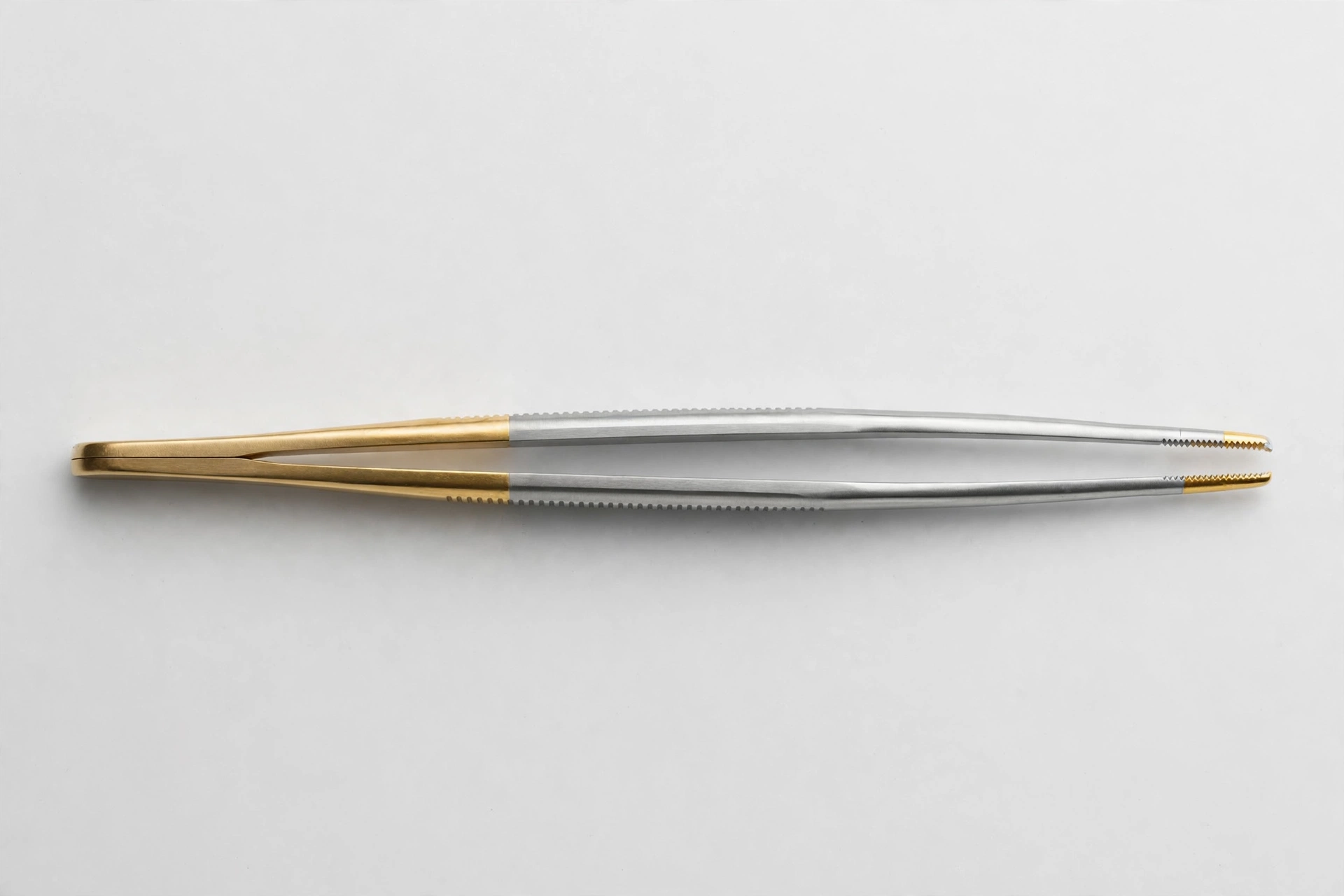
Some instruments earn their place on the tray by doing one job perfectly, case after case. The Adson Dressing Forceps – Tungsten Carbide Serrated is one of them. It is a thumb forceps built for holding and positioning dressings and delicate tissue — and it adds one decisive upgrade to the classic Adson dressing pattern: tungsten carbide inserts in the jaws. The result is a grip that stays firm and non-slip far longer than plain steel serrations, in an instrument that still feels light and precise in the hand.
What Are Adson Dressing Forceps?
The Adson Dressing Forceps – Tungsten Carbide Serrated is a thumb forceps — a tweezer-style instrument squeezed between thumb and forefinger to grasp, hold and position tissue. The Adson pattern is one of the most familiar in surgery, and the dressing version is its gentler sibling. Where a tissue forceps carries teeth that bite into skin to hold it firmly, a dressing forceps has fine serrated jaws with no teeth at all. The serrations grip dressings, swabs and gauze securely without piercing or tearing the material, and they hold delicate tissue without leaving tooth marks.
What sets this version apart is the tungsten carbide. Fine serrated tungsten carbide inserts are set into the jaws, giving a harder, longer-lasting gripping surface than stainless steel alone. Tungsten carbide keeps its edge and its grip through repeated use and autoclaving, so the jaws still hold firmly years into the instrument’s life instead of gradually going smooth. The gold-plated handles give the instrument a balanced, comfortable grip and make the tungsten carbide pattern easy to identify on a crowded tray. The smooth satin finish reduces glare under theatre lighting, so the instrument does not flash in the surgeon’s eyes at the wrong moment.
Sizes and Options: How This Pattern Is Specified
The Adson Dressing Forceps – Tungsten Carbide Serrated comes in two lengths, two teeth options and two forms. The choice depends on the depth of the field, the tissue being held, and the angle of approach:
- 12 cm length — the shorter pattern, for surface work, dressing changes and minor procedures where the field is shallow and the hand works close to the tissue. Priced at $45.
- 15 cm length — the longer pattern, for a slightly deeper field, where a little extra reach keeps the fingers clear of the wound. Priced at $50.
- 1×2 teeth — a single tooth meeting two, for a focused, precise grip on a small point of tissue or dressing.
- 2×3 teeth — two teeth meeting three, spreading the grip over a slightly wider area for a firmer hold on dressings and tissue.
- Straight type — the classic straight profile, for direct work in an open, shallow field.
- Angled type — an angled jaw that reaches around a corner or into a recess, keeping the hand out of the line of sight.
The price depends on length alone: $45 for the 12 cm pattern and $50 for the 15 cm pattern, whichever teeth option and form you choose. The longer length adds only $5, so the choice is genuinely about the work, not the price. The tip width of 1.0–1.5 mm keeps the jaws fine enough for delicate work while the serrated tungsten carbide surface does the holding. Every option is made from the same surgical-grade stainless steel, and every one is reusable and suitable for repeated autoclave sterilisation.
Where Are Adson Dressing Forceps Used?
Because the pattern is designed for holding rather than biting, this forceps appears on trays wherever dressings and delicate tissue must be handled cleanly:
- Dressing changes and wound care — placing, adjusting and removing dressings, swabs and gauze, where the serrated tungsten carbide jaws grip firmly without tearing the material.
- Plastic surgery — handling delicate tissue and dressings during closure and reconstruction, where a toothed bite would mark the tissue but a slipping jaw would be worse.
- Reconstructive surgery — holding fine tissue and grafts in position while they are sutured, where a gentle but secure hold matters more than a hard grip.
- ENT surgery — the angled form in particular suits the narrow, recessed fields of ear, nose and throat work, where the hand must stay clear of the line of sight.
- General surgery — an all-round dressing forceps for the everyday work of holding dressings and tissue during minor procedures, with a grip that outlasts plain steel serrations.
If you are equipping a full tray, browse our complete Thumb Forceps collection — it covers Adson, Cushing, DeBakey, Gerald and many other patterns alongside this dressing forceps.
How to Choose the Right Pair
Three questions settle the choice. First, how deep is the field? For surface work and dressing changes, the 12 cm pattern keeps the hand close to the tissue; for a deeper field, the 15 cm pattern gives the extra reach without changing the feel of the instrument. Second, how much grip do you need? The 1×2 teeth suit a fine, focused hold on a small point; the 2×3 teeth spread the grip for a firmer hold on dressings that must not slip. Third, straight or angled? Choose straight for direct, open work and angled where the approach is around a corner or into a recess — in ENT work, for example, the angled jaw keeps the hand out of the surgeon’s view.
Care, Cleaning and Sterilization
A quality forceps should last for years, and most early failures come from handling rather than manufacture. Rinse instruments as soon as possible after use so blood and saline do not dry on the surface. Clean with a soft brush and a neutral-pH detergent, paying attention to the fine serrations, where debris collects — take care not to scour the tungsten carbide inserts, which do the gripping. Rinse in clean water and dry fully — trapped moisture is the main cause of staining — then check the jaw alignment before packing: the serrated faces should meet evenly along their full length, with no crossed or bent tips. These forceps are fully autoclavable; follow your facility’s standard steam sterilization cycle, and store the instrument with the tips protected so the fine points are not bent by heavier instruments in the tray.
Why Surgeons Buy From Surgi Right
Surgi Right Instruments manufactures its forceps in Daska, Pakistan — a city known worldwide for surgical instrument craftsmanship — and every instrument is quality-checked before dispatch. Our production is certified to ISO 9001:2015 and BS EN ISO 13485:2016, and our Class I devices are registered in Europe through our authorised representative; you can view the documents on our certificates page. We back our instruments with a lifetime warranty, ship worldwide, and delivery is free on orders over $450.
The Bottom Line
If your tray needs a dressing forceps that grips without tearing, holds without slipping, and keeps that grip through years of autoclaving, the Adson Dressing Forceps – Tungsten Carbide Serrated is the pattern to reach for. Choose the 12 cm or 15 cm length, the 1×2 or 2×3 teeth, and the straight or angled form that suits your work, and order the Adson Dressing Forceps – Tungsten Carbide Serrated here — or contact us for bulk, OEM and private-label enquiries.
