


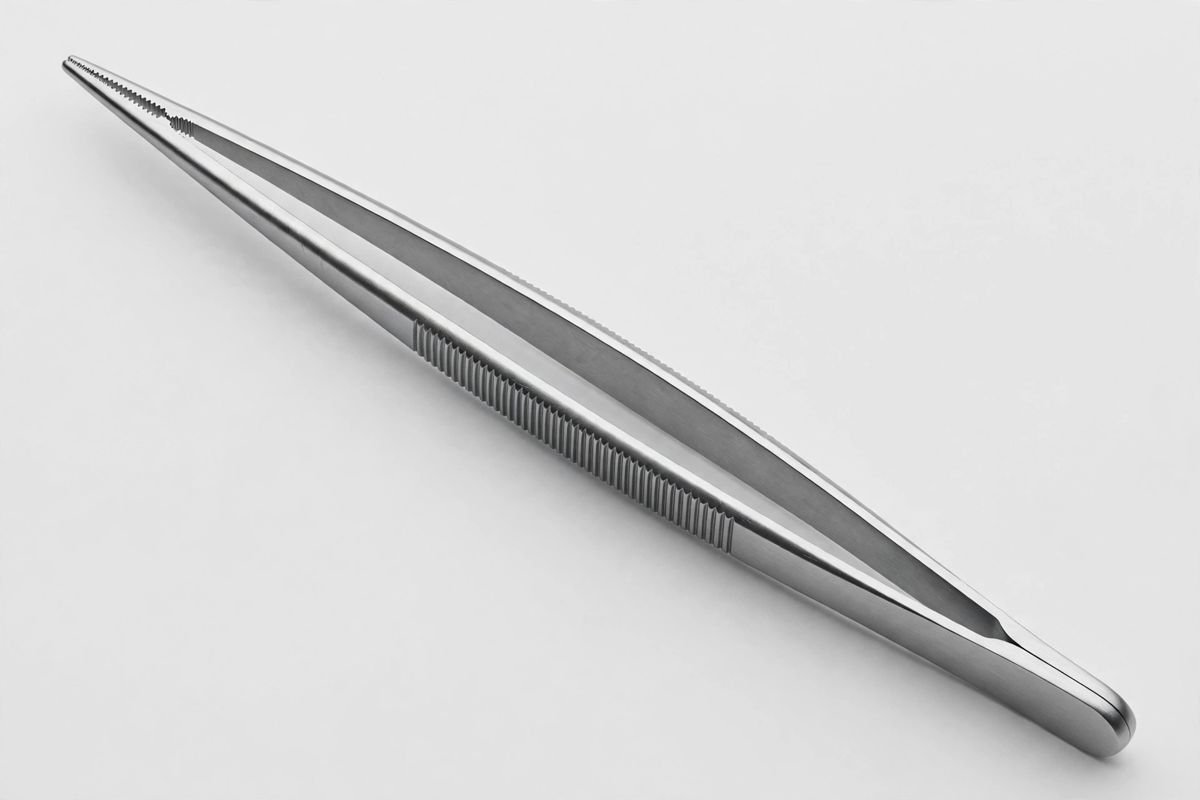
Every theatre has moments when the tissue in front of the surgeon is too delicate for an ordinary grip — a thin skin flap, a fine mucosal edge, or a small piece of tissue that must be held still for a suture without being crushed. That is the exact job the Adson Beasley-Babcock Tissue Forceps was designed for. Its fine, sharply pointed tips meet in a precise 6×6 interlocking tooth pattern that holds tissue securely, while the spring handle gives the surgeon light, controlled fingertip pressure. In this guide we look at what the Beasley-Babcock pattern is, where it is used, how to choose the right pair, and how to keep it performing like new.
What Are Adson Beasley-Babcock Tissue Forceps?
The Adson Beasley-Babcock Tissue Forceps is a thumb forceps — a tweezer-style instrument that the surgeon squeezes between thumb and forefinger to grasp, hold and position tissue. Unlike ring-handled forceps, thumb forceps give direct, fingertip control, which makes them ideal for delicate work where feel matters as much as grip.
What sets this pattern apart is its tip. The fine, sharply pointed tips are just 3.5 mm wide and meet in a 6×6 interlocking tooth pattern — six small teeth on each side that mesh together when the jaws close. The teeth bite gently into the tissue surface so the hold does not slip, while the narrow contact area limits the pressure on the tissue itself. It is the combination that lets the surgeon hold a delicate fold of tissue firmly without crushing it.
The rest of the instrument is built around the same idea of control. The straight, slim profile keeps the forceps light and balanced in the hand, and the Adson thumb-style handle has a spring joint with a serrated grip, so the jaws open by themselves when the pressure is released and stay steady under the fingers during use. A smooth satin finish reduces glare under theatre lighting, so the instrument does not throw reflections back into the surgeon’s eyes during fine work.
Sizes and Options: How This Pattern Is Specified
Our Adson Beasley-Babcock Tissue Forceps (SR788115) is made in one length — 12 cm — so choosing it is less about size and more about matching the pattern to the job:
- 12 cm length — short and light, which suits superficial work and smaller hands, and keeps the instrument nimble for fine, close-up handling.
- Fine toothed jaws, 6×6 teeth — the interlocking tooth pattern grips tissue securely with a light touch, holding a fold of tissue without tearing or crushing it.
- 3.5 mm tip width — slim enough to pick up a precise edge of tissue or a fine suture line in a confined field without blocking the surgeon’s view.
- Adson thumb-style handle with spring joint and serrated grip — the spring returns the jaws open, the serrations keep the instrument steady, and the whole grip works on fingertip pressure alone.
- Straight, slim profile with a satin finish — a clean, low-glare instrument that sits comfortably in the hand through a long list.
- Surgical-grade stainless steel — the whole instrument is reusable and suitable for repeated autoclave sterilisation.
The price is $62, and every pair is in stock.
Where Are Adson Beasley-Babcock Tissue Forceps Used?
Because the pattern balances a secure grip with gentleness, this forceps appears on trays wherever delicate tissue must be held still:
- Plastic and reconstructive surgery — handling skin flaps and delicate tissue during closure, where a firm hold must not leave a crush injury behind.
- General surgery — holding tissue during dissection and suturing, especially where the tissue edge is thin and a broader forceps would cover too much of the field.
- ENT and head-and-neck work — precise handling in narrow fields, where the slim 3.5 mm tips can reach a fine edge without crowding it.
- Dermatology and minor procedures — grasping small skin edges during excision and closure in the clinic.
- Ophthalmic and delicate microsurgical work — the fine pointed tips suit procedures where the tissue is thin and the margin for error is small.
- Ward and clinic dressing changes — the same forceps doubles as a dressing forceps for handling gauze and removing sutures, which is why many theatres keep several pairs in rotation.
If you are equipping a full tray, browse our complete Thumb Forceps collection — it covers Adson, Cushing, DeBakey, Gerald and many other patterns alongside the Beasley-Babcock, all in the same surgical-grade stainless steel.
How to Choose the Right Pair
Three questions settle the choice in most cases. First, how delicate is the tissue? Fragile tissue that must not be crushed pairs with a fine-toothed pattern like this one; tougher tissue that would slip from a fine pattern may need a broader, heavier-toothed forceps from the same range. Second, how fine is the work? The 3.5 mm tips suit precise, close-up handling — picking up a single fold of tissue or a suture edge — while a broader tip suits general holding. Third, how long are your procedures? A short, light 12 cm instrument reduces hand fatigue over a long list, so many surgeons keep this pair in the set alongside a longer forceps for deeper fields.
If you are buying for a set, it is worth keeping both: a fine-toothed pair like the Beasley-Babcock for delicate tissue, and a serrated dressing forceps for gauze and dressings. The two patterns complement each other, and at $62 the Beasley-Babcock is an easy addition to a tray that already works hard.
Care, Cleaning and Sterilization
A quality forceps should last for years, and most early failures come from handling rather than manufacture. Rinse instruments as soon as possible after use so blood and saline do not dry on the surface. Clean with a soft brush and a neutral-pH detergent, paying attention to the teeth and the serrated thumb grip, where debris collects. Rinse in clean water, dry fully — trapped moisture is the main cause of staining — and check the tip alignment before packing: the 6×6 teeth should meet evenly, with no crossed or bent points. Adson Beasley-Babcock forceps are fully autoclavable; follow your facility’s standard steam sterilization cycle, and store the instrument with the tips protected so the fine points are not bent by heavier instruments in the tray.
Why Surgeons Buy From Surgi Right
Surgi Right Instruments manufactures its forceps in Daska, Pakistan — a city known worldwide for surgical instrument craftsmanship — and every instrument is quality-checked before dispatch. Our production is certified to ISO 9001:2015 and BS EN ISO 13485:2016, and our Class I devices are registered in Europe through our authorised representative; you can view the documents on our certificates page. We back our instruments with a lifetime warranty against manufacturing defects, ship worldwide, and delivery is free on orders over $450.
The Bottom Line
If your tray is missing a fine-toothed tissue forceps that holds delicate tissue securely without crushing it, the Adson Beasley-Babcock pattern is the classic answer. Choose it for the work where a light, precise grip matters, and order the Adson Beasley-Babcock Tissue Forceps here — or contact us for bulk, OEM and private-label enquiries.
