


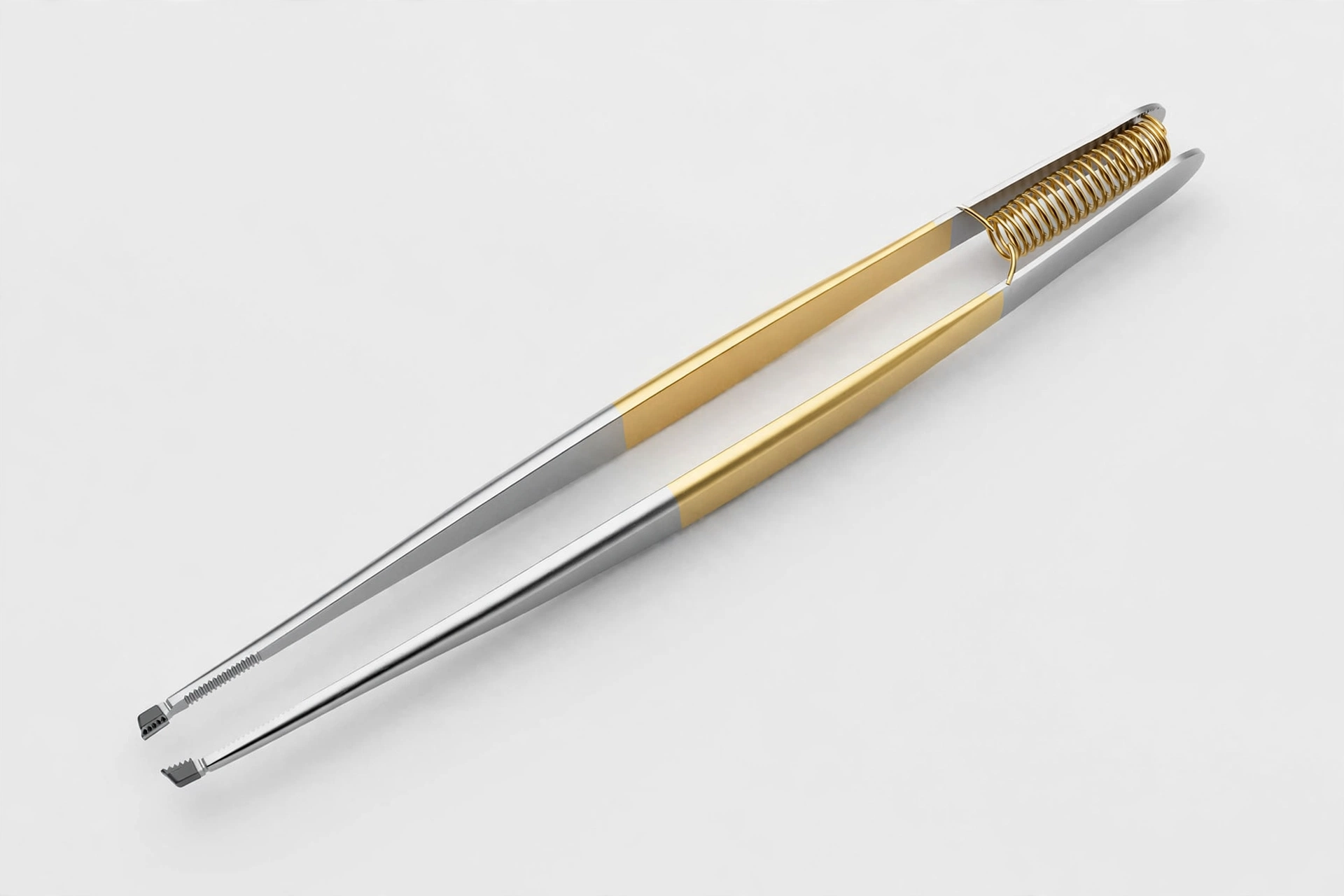
Eyelid surgery leaves no room for a clumsy grip. The skin of the eyelid is the thinnest on the human body, the field is small, and a forceps that slips, crushes or blocks the view can turn a precise blepharoplasty into a repair job. That is why eyelid surgeons reach for a dedicated pattern: the Adson Blepharoplasty Forceps – Tungsten Carbide. Its fine serrated jaws hold delicate eyelid tissue steadily without slipping, its slim straight profile keeps the field in view, and its gold-plated spring handles give a balanced, comfortable grip through a long list. In this guide we look at what this forceps is, where it is used, how to choose the right pair, and how to keep it performing like new.
What Are Adson Blepharoplasty Forceps – Tungsten Carbide?
The Adson Blepharoplasty Forceps – Tungsten Carbide is a thumb forceps — a tweezer-style instrument that the surgeon squeezes between thumb and forefinger to grasp, hold and position tissue. Unlike ring-handled forceps, thumb forceps give direct, fingertip control, which matters most in the fine, close-up work of the eyelid, where feel matters as much as grip.
What sets this pattern apart is its jaw. The jaws are fine and serrated, with tungsten carbide inserts — hard metal pads set into the gripping surface that bite gently into tissue and keep their grip far longer than plain steel serrations. On eyelid skin, which is thin and easily marked, that matters twice over: the tungsten carbide holds the tissue steadily with light pressure, so the surgeon does not have to squeeze hard, and the hold does not slip midway through a cut or a suture.
The tip is built for the same precision. At just 12 mm long and 1.4–1.5 mm wide, it picks up a fine edge of eyelid skin or a small fold of tissue without covering the field, so the surgeon can see exactly what the jaws are holding. The slim, straight profile of the whole instrument keeps the line of sight clear, which is essential when the working area is only a few centimetres across.
The handle is the part the surgeon feels all day. Gold-plated spring handles give the instrument a balanced, comfortable grip: the spring returns the jaws open when pressure is released, so the hand does not tire holding them apart, and the gold plating marks the tungsten carbide pattern at a glance on a crowded tray. A smooth satin finish reduces glare under theatre lighting, so the instrument does not throw reflections back into the surgeon’s eyes during fine work.
Sizes and Options: How This Pattern Is Specified
Our Adson Blepharoplasty Forceps – Tungsten Carbide (SR788363) is made in one size — 12.7 cm (5″) — so choosing it is less about size and more about matching the pattern to the job:
- 12.7 cm (5″) length — short and light, which suits the shallow, close-up field of eyelid surgery and keeps the instrument nimble in the hand.
- Fine serrated jaws with tungsten carbide inserts — the TC pads grip delicate eyelid tissue securely with light pressure and keep their edge through many procedures, outlasting plain steel serrations.
- 12 mm tip, 1.4–1.5 mm wide — slim enough to pick up a precise edge of eyelid skin without blocking the surgeon’s view of the field.
- Gold-plated spring handles — the spring returns the jaws open, the gold plating identifies the TC pattern instantly on the tray, and the whole grip works on fingertip pressure alone.
- Straight, slim profile with a satin finish — a clean, low-glare instrument that sits comfortably in the hand through a long list.
- Surgical-grade stainless steel — the whole instrument is reusable and suitable for repeated autoclave sterilisation.
The price is $89.99, and every pair is in stock.
Where Are Adson Blepharoplasty Forceps Used?
Because the pattern balances a secure grip with gentleness on very thin tissue, this forceps appears on trays wherever eyelid and delicate facial tissue must be held still:
- Blepharoplasty (eyelid surgery) — its home procedure: holding thin eyelid skin and the fine tissue beneath it during excision, repositioning and closure, where a firm hold must not leave a crush injury behind.
- Oculoplastic surgery — precise handling in the narrow field around the eye, where the slim 1.4 mm tips can reach a fine edge without crowding it.
- Facial plastic and reconstructive surgery — handling delicate facial skin flaps and fine tissue during closure, where a broader forceps would cover too much of the field.
- ENT and head-and-neck work — the fine serrated TC jaws suit procedures where the tissue is thin and the margin for error is small.
- Dermatology and minor procedures — grasping small skin edges during excision and closure in the clinic.
- General delicate tissue work — any procedure where a light, precise grip on thin tissue matters more than a heavy hold.
If you are equipping a full tray, browse our complete Thumb Forceps collection — it covers Adson, Cushing, DeBakey, Gerald and many other patterns alongside the blepharoplasty pattern, all in the same surgical-grade stainless steel.
How to Choose the Right Pair
Three questions settle the choice in most cases. First, how delicate is the tissue? Eyelid skin and other very thin tissue pair with a fine-toothed or fine-serrated TC pattern like this one; tougher tissue that would slip from a fine pattern may need a broader, heavier-toothed forceps from the same range. Second, how fine is the work? The 1.4–1.5 mm tips suit precise, close-up handling — picking up a single fold of eyelid skin or a suture edge — while a broader tip suits general holding. Third, how long are your procedures? A short, light 12.7 cm instrument reduces hand fatigue over a long list, so many surgeons keep this pair in the set alongside a longer forceps for deeper fields.
If you are buying for a set, it is worth keeping both: a fine TC pair like the blepharoplasty pattern for eyelid and delicate facial work, and a serrated dressing forceps for gauze and dressings. The two patterns complement each other, and at $89.99 the blepharoplasty forceps is an easy addition to a tray that already works hard.
Care, Cleaning and Sterilization
A quality forceps should last for years, and most early failures come from handling rather than manufacture. Rinse instruments as soon as possible after use so blood and saline do not dry on the surface. Clean with a soft brush and a neutral-pH detergent, paying attention to the serrated jaws and the tungsten carbide inserts, where debris collects. Rinse in clean water, dry fully — trapped moisture is the main cause of staining — and check the tip alignment before packing: the fine jaws should meet evenly, with no crossed or bent points, and the gold plating should be intact. Adson Blepharoplasty forceps are fully autoclavable; follow your facility’s standard steam sterilization cycle, and store the instrument with the tips protected so the fine points are not bent by heavier instruments in the tray.
Why Surgeons Buy From Surgi Right
Surgi Right Instruments manufactures its forceps in Daska, Pakistan — a city known worldwide for surgical instrument craftsmanship — and every instrument is quality-checked before dispatch. Our production is certified to ISO 9001:2015 and BS EN ISO 13485:2016, and our Class I devices are registered in Europe through our authorised representative; you can view the documents on our certificates page. We back our instruments with a lifetime warranty against manufacturing defects, ship worldwide, and delivery is free on orders over $450.
The Bottom Line
If your tray is missing a fine forceps that holds eyelid tissue steadily without slipping or crushing it, the Adson Blepharoplasty pattern with tungsten carbide jaws is the classic answer. Choose it for the work where a light, precise grip matters, and order the Adson Blepharoplasty Forceps – Tungsten Carbide here — or contact us for bulk, OEM and private-label enquiries.
