


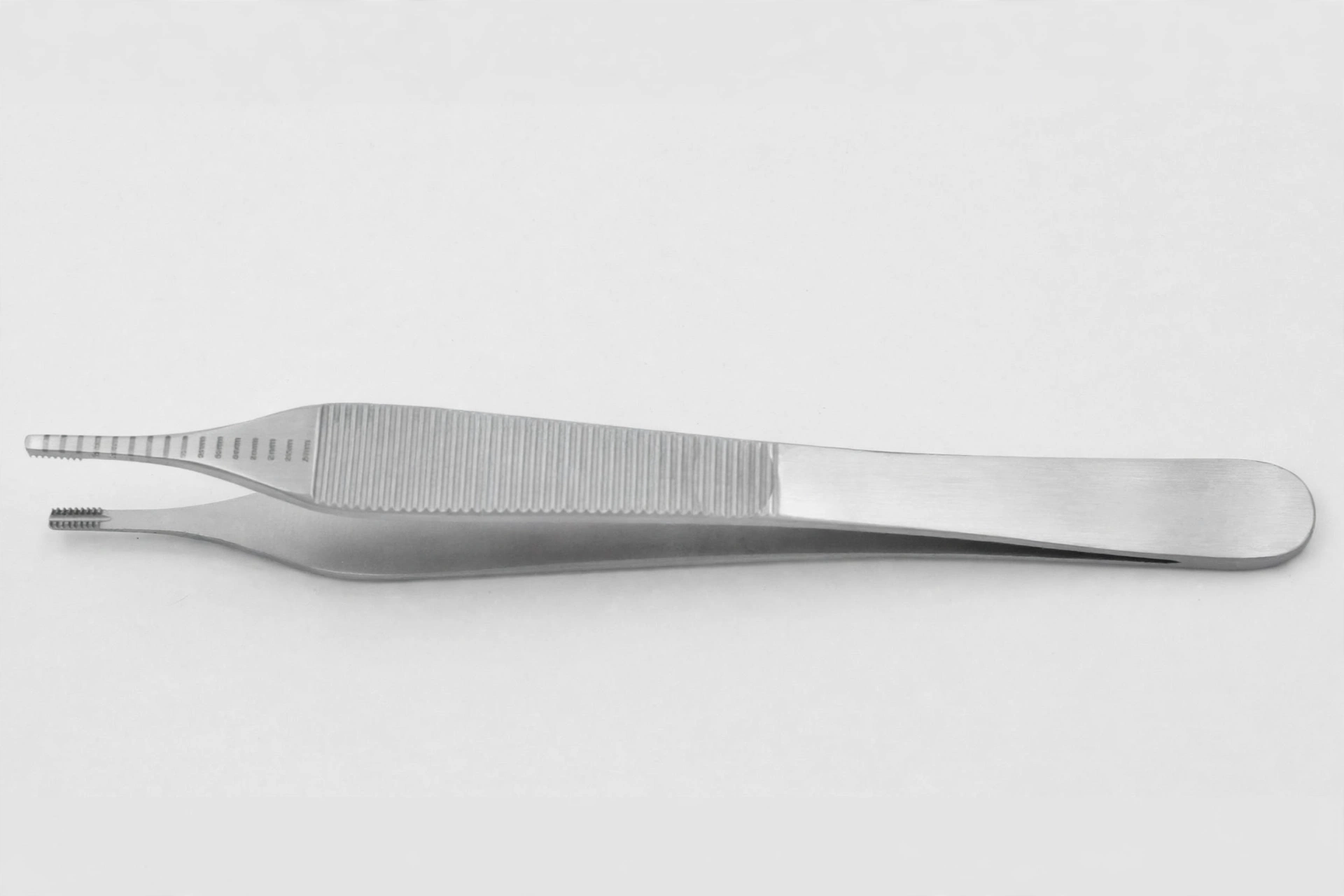
In cartilage surgery, a millimetre is not a rounding error. A graft cut a little too long will not sit where it should, one cut a little too short will not do the job, and every time the surgeon puts the graft down to reach for a ruler, the field is disturbed and the rhythm breaks. The Adson Cartilage Measuring Forceps solves that: it holds the cartilage and measures it in the same motion. Its fine serrated jaws grip a piece of cartilage securely, while a 2 cm graduated scale on the tips lets the surgeon read the size of a graft before cutting or shaping it. In this guide we look at what this forceps is, where it is used, how to choose between its two teeth options, and how to keep it performing like new.
What Are Adson Cartilage Measuring Forceps?
The Adson Cartilage Measuring Forceps is a thumb forceps — a tweezer-style instrument squeezed between thumb and forefinger to grasp, hold and position tissue. Unlike ring-handled forceps, thumb forceps give direct, fingertip control, which matters in the fine, close-up work of plastic and reconstructive surgery, where feel matters as much as grip.
What sets this pattern apart is the scale on its tips. The tips are 1.5–2 mm wide and carry measuring markings across 2 cm, so the surgeon can size a cartilage graft while it is still held in the jaws — no putting the graft down, no reaching for a separate ruler, no guessing.
The jaws are built for the same job. They are fine and serrated, so they hold cartilage — a firm, slippery tissue — securely without slipping, while the narrow contact area keeps the pressure on the tissue itself low. The slim, straight profile keeps the line of sight clear, which matters when the working area is small. The spring handle returns the jaws open when pressure is released, so the hand does not tire, and gives light, controlled fingertip pressure through a long list. A smooth satin finish reduces glare under theatre lighting.
Sizes and Options: How This Pattern Is Specified
Our Adson Cartilage Measuring Forceps (SR020217) is made in one length — 12 cm — and the choice is the teeth pattern. Both options cost $91, so the decision is purely about the tissue you work with:
- 12 cm length — short and light, which suits the shallow, close-up field of cartilage work and keeps the instrument nimble in the hand.
- Teeth 7×7 — seven small teeth on each jaw that mesh when the jaws close, giving a firm, even hold on cartilage that needs a secure grip without a heavy bite.
- Teeth 9×9 — nine finer teeth on each jaw, spreading the grip across more points of contact for a slightly gentler hold on more delicate pieces.
- 2 cm measuring scale on the tips — graduated markings on the 1.5–2 mm wide tips, so grafts can be sized accurately before cutting or shaping, with no separate measuring tool in the field.
- Fine serrated jaws — the serrations bite gently into firm cartilage so the hold does not slip midway through a cut or a suture.
- Spring handle with a slim, straight profile — the spring returns the jaws open, the straight shape keeps the field in view, and the grip works on fingertip pressure alone.
- Surgical-grade stainless steel — reusable and suitable for repeated autoclave sterilisation.
If you are unsure which teeth pattern to start with, the 7×7 is the everyday choice for firm cartilage, while the 9×9 suits the more delicate pieces. Many surgeons keep both on the tray and reach for whichever matches the piece in front of them.
Where Are Adson Cartilage Measuring Forceps Used?
Because the pattern combines a secure grip with a built-in measurement, this forceps appears on trays wherever cartilage must be sized and shaped precisely:
- Rhinoplasty (nose surgery) — its home procedure: holding and measuring septal or ear cartilage grafts before they are cut and shaped for the nose, where a graft a few millimetres out can change the result.
- Plastic and reconstructive surgery — sizing cartilage grafts in facial reconstruction, where the graft must match a defect or a contour exactly.
- Ear reconstruction — handling and measuring the small pieces of cartilage used to rebuild the ear, where the pieces are small and the tolerances are tight.
- Cartilage graft harvesting — measuring a piece of cartilage as it is taken, so the surgeon knows immediately whether it is enough.
- ENT and head-and-neck work — holding and sizing cartilage around the nose and ear, where the field is narrow and the tissue is firm and slippery.
- General delicate tissue work — any procedure where tissue must be held still and measured at the same time, without a second instrument in the field.
If you are equipping a full tray, browse our complete Thumb Forceps collection — it covers Adson, Cushing, DeBakey, Gerald and many other patterns alongside the cartilage measuring pattern, all in the same surgical-grade stainless steel.
How to Choose the Right Pair
Three questions settle the choice. First, how firm is the cartilage? Firm septal or costal cartilage pairs well with the 7×7 teeth, which give a secure hold across fewer, slightly larger points of contact; softer or more delicate pieces suit the finer 9×9 pattern, which spreads the grip. Second, how much measuring do you do in the field? If you size grafts as you go, the 2 cm scale on the tips is the feature you will use on every case — and it is the same on both options. Third, how long are your procedures? A short, light 12 cm instrument reduces hand fatigue over a long list, and the spring handle means the hand is not working to hold the jaws open between grips.
If you are buying for a set, keep both teeth options: a 7×7 pair for the firm grafts and a 9×9 pair for the delicate pieces. At $91 each, the second pair is an easy addition to a tray that already works hard.
Care, Cleaning and Sterilization
A quality forceps should last for years, and most early failures come from handling rather than manufacture. Rinse instruments as soon as possible after use so blood and saline do not dry on the surface. Clean with a soft brush and a neutral-pH detergent, paying attention to the serrated jaws and the teeth, where debris collects, and to the measuring markings on the tips — dried debris in the engraved scale makes it hard to read. Rinse in clean water and dry fully — trapped moisture is the main cause of staining — then check the tip alignment before packing: the fine jaws should meet evenly, with no crossed or bent points, and the scale markings should be clear and legible. These forceps are fully autoclavable; follow your facility’s standard steam sterilization cycle, and store the instrument with the tips protected so the fine points are not bent by heavier instruments in the tray.
Why Surgeons Buy From Surgi Right
Surgi Right Instruments manufactures its forceps in Daska, Pakistan — a city known worldwide for surgical instrument craftsmanship — and every instrument is quality-checked before dispatch. Our production is certified to ISO 9001:2015 and BS EN ISO 13485:2016, and our Class I devices are registered in Europe through our authorised representative; you can view the documents on our certificates page. We back our instruments with a lifetime warranty, ship worldwide, and delivery is free on orders over $450.
The Bottom Line
If your tray is missing a forceps that holds cartilage securely and measures it in the same motion, the Adson Cartilage Measuring pattern is the classic answer. Choose the 7×7 teeth for firm grafts or the 9×9 for more delicate pieces, and order the Adson Cartilage Measuring Forceps here — or contact us for bulk, OEM and private-label enquiries.
